---
title: "AI, influence, brand, and customers: four skills defining marketing leadership in 2026"
description: "Learn about the four essential skills for marketing leaders in 2026: AI literacy, cross-functional influence, and customer intelligence."
image: https://blog.thrivedigital.com/hubfs/2x1_Thrive%20Blog_AI%2c%20influence%2c%20brand%2c%20and%20customers.png
---
Menu
- [Work](https://thrivedigital.com/work)
- [Process](https://thrivedigital.com/process)
- [About](https://thrivedigital.com/about)
- [Careers](https://thrivedigital.com/careers)
- [Blog](https://blog.thrivedigital.com)
- [Contact](https://thrivedigital.com/contact)
-
- ---
July 16, 2026
# AI, influence, brand, and customers: four skills defining marketing leadership in 2026
.png) *Santana Blanchette*
[Back to Blog Listings](https://blog.thrivedigital.com)


*TL;DR*
*AI makes up 17% of marketing activity today and is heading to 44% within three years. To stay ahead of it, leaders need to understand what AI is actually doing inside their platforms well enough to direct it, not just accept vendor recommendations. Cross-functional influence starts with investing in relationships with finance, product, and sales before you need something from them, and communicating marketing's value in their language, not yours. Brand and performance should share a single view of data and a single measurement framework, even an imperfect one, so budget decisions are made on a consistent basis across the whole portfolio. And customer intelligence needs to be an ongoing habit, not a project. Leaders who stay close to qualitative signals like customer conversations and sales call patterns make better strategic decisions than those who rely on performance dashboards alone.*
---
Marketing leaders’ job descriptions have changed faster in the last three years than in the previous decade. According to the CMO Survey, AI has doubled its share of marketing activity since 2022 and is projected to reach 44% within three years, while CEOs are also asking marketing to own revenue growth, customer insight, and board-level reporting simultaneously.
The leaders navigating this well have a broader and more deliberate skill set than most.
[In Part 1](https://blog.thrivedigital.com/what-skills-do-marketing-leaders-need-in-2026-part-1) of this series, we covered financial fluency and measurement discipline, the two capabilities most directly tied to marketing's credibility with the C-suite. This issue covers the other four: AI literacy, cross-functional influence, full-funnel thinking, and customer intelligence. Three of them are among the fastest-growing challenges for marketing leaders right now. The fourth is being deprioritized by most organizations at exactly the moment it matters most.
## AI literacy
#### If you don't understand how AI works in your marketing stack, someone else is making those decisions for you
AI is increasingly embedded in the infrastructure of marketing decisions. It influences how bids are set, how audiences are segmented, how creative gets optimized, and how performance gets reported. Most of that is happening inside vendor platforms, using logic that isn't always visible or explained.
Marketing leaders who understand how these systems work can ask better questions, set smarter constraints, and evaluate vendor claims with more confidence. Those who don't tend to accept whatever the platform recommends and measure success by whatever metric the dashboard surfaces by default.
### Why most AI adoption is still surface-level
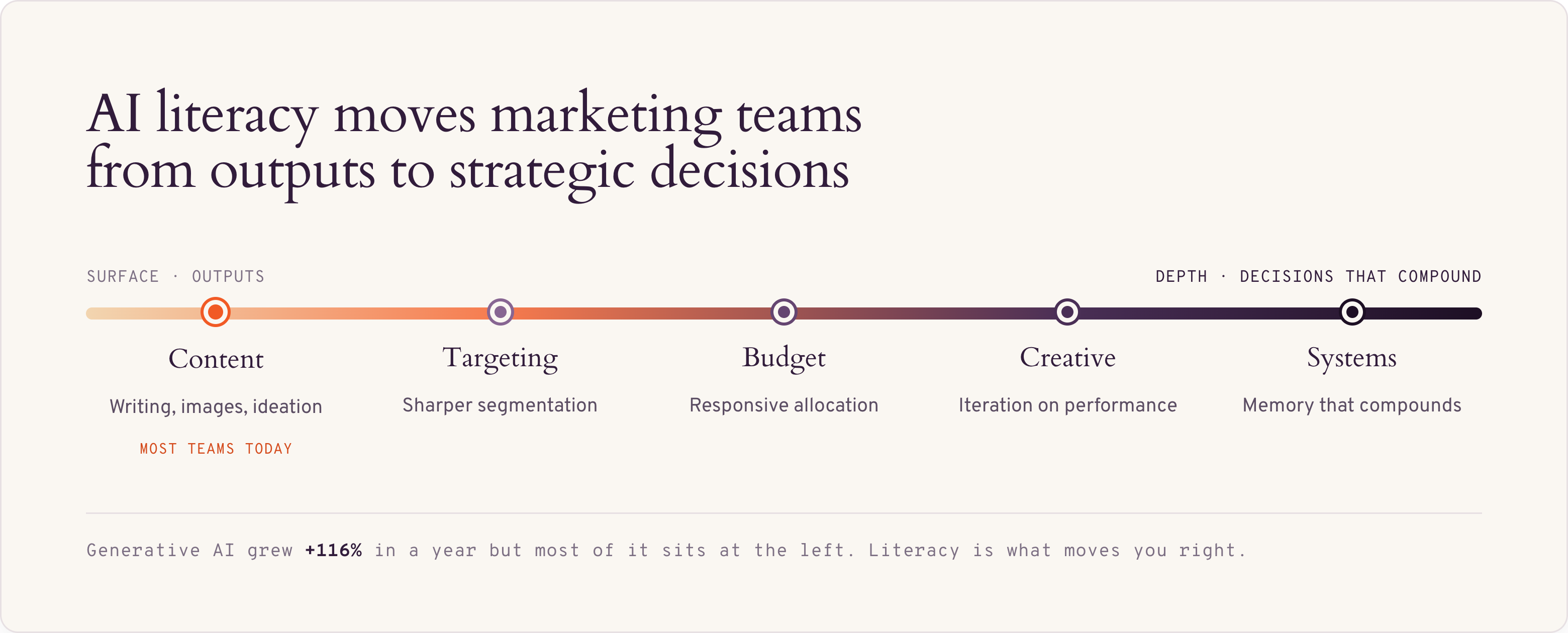
Generative AI has seen the most visible adoption, growing 116% in the past year alone, now used in 15.1% of marketing activities compared to 7.0% one year ago[(CMO Survey, 2025)](https://cmosurvey.org/cmosurvey_results/The_CMO_Survey-Highlights_and_Insights_Report-2025.pdf). Most of that growth is in content production: writing, image generation, and ideation. That's a good use, but it's only part of what AI can do for a marketing organization.
The deeper opportunity is in how AI can improve the quality of decisions: better audience targeting, more responsive budget allocation, faster creative iteration grounded in performance data. Getting there requires marketing leaders who understand enough about how these tools work to direct them purposefully, rather than adopting them because a vendor recommended them or a competitor might be using them.
The tools-first trap from [Part 1](https://blog.thrivedigital.com/what-skills-do-marketing-leaders-need-in-2026-part-1) applies here too. AI tools adopted without a clear business problem to solve tend to produce impressive-looking outputs that don't change how decisions get made.
### What good AI adoption looks like on a marketing team
AI literacy for a marketing leader doesn't mean being able to build models or write code. It means being able to:
- Understand what AI is actually doing inside the platforms you're already running, including how automated bidding works, what signals it's optimizing for, and what constraints you can set
- Evaluate vendor AI claims with enough knowledge to ask meaningful questions rather than accepting capability claims at face value
- Identify where AI can genuinely improve decision quality in your specific marketing mix, and where it introduces risk or reduces visibility
- Build a team with the technical depth to manage AI-driven systems, even if that expertise sits with specialists rather than the leader directly
- Take a systems thinking approach: build AI into your marketing operation in a way that improves over time, capturing the right context about your business, test results, historical performance, and account changes as it goes
- Recognize one of AI's biggest advantages is memory. Unlike a person, it can retain the full history of marketing decisions, which makes it easier over time to see what's actually working and what isn't
## Cross-functional influence
### Marketing teams working in isolation don’t get the resources or organizational support they need
Securing cross-functional support for new marketing investments has grown 23.6% as a challenge since 2023, now affecting more than a third of senior marketing leaders[(CMO Survey, 2025)](https://cmosurvey.org/cmosurvey_results/The_CMO_Survey-Highlights_and_Insights_Report-2025.pdf).
Most marketing organizations were built to operate as a contained function: set the strategy, run the campaigns, report the results. But the scope of what marketing is now responsible for (revenue growth, customer insight, board-level reporting) requires input and cooperation from teams that don't report to marketing and aren't automatically aligned with its priorities.
Tired of surface-level marketing advice?
Our monthly newsletter dives deep into one topic that matters: whether it's cracking attribution models, scaling creative production, or building dashboards that actually drive decisions. Real strategies, real results.
First Name
Last Name
Email Address
Join our newsletter →
✓ One topic per month ✓ No spam, ever ✓ Unsubscribe anytime
### How to collaborate across departments
Building cross-functional influence is less about personality and more about habits built over time. The marketing leaders who do it well tend to share a few common practices:
- They invest time in understanding the priorities and pressures of the other parts of the organization they depend on, including finance, product, sales, and operations, before they need something from them
- They communicate marketing's contribution in terms that matter to those teams, not just in marketing metrics
- They create shared understanding and goals between marketing and other functions so all requests feel aligned
- They treat the sales relationship as a priority, not an afterthought. It's one of the longest-standing and hardest relationships for a marketing leader to get right, and it's worth pushing for real alignment: shared goals, shared metrics, and a working relationship where the two functions operate as partners instead of separate silos
In an environment where marketing budgets are the first to be cut under financial pressure, leaders with strong internal relationships are better positioned to make the case for marketing's value before the cuts happen, not after.
## Full-funnel thinking
### Splitting brand and performance into separate functions with separate goals is an expensive structural mistake
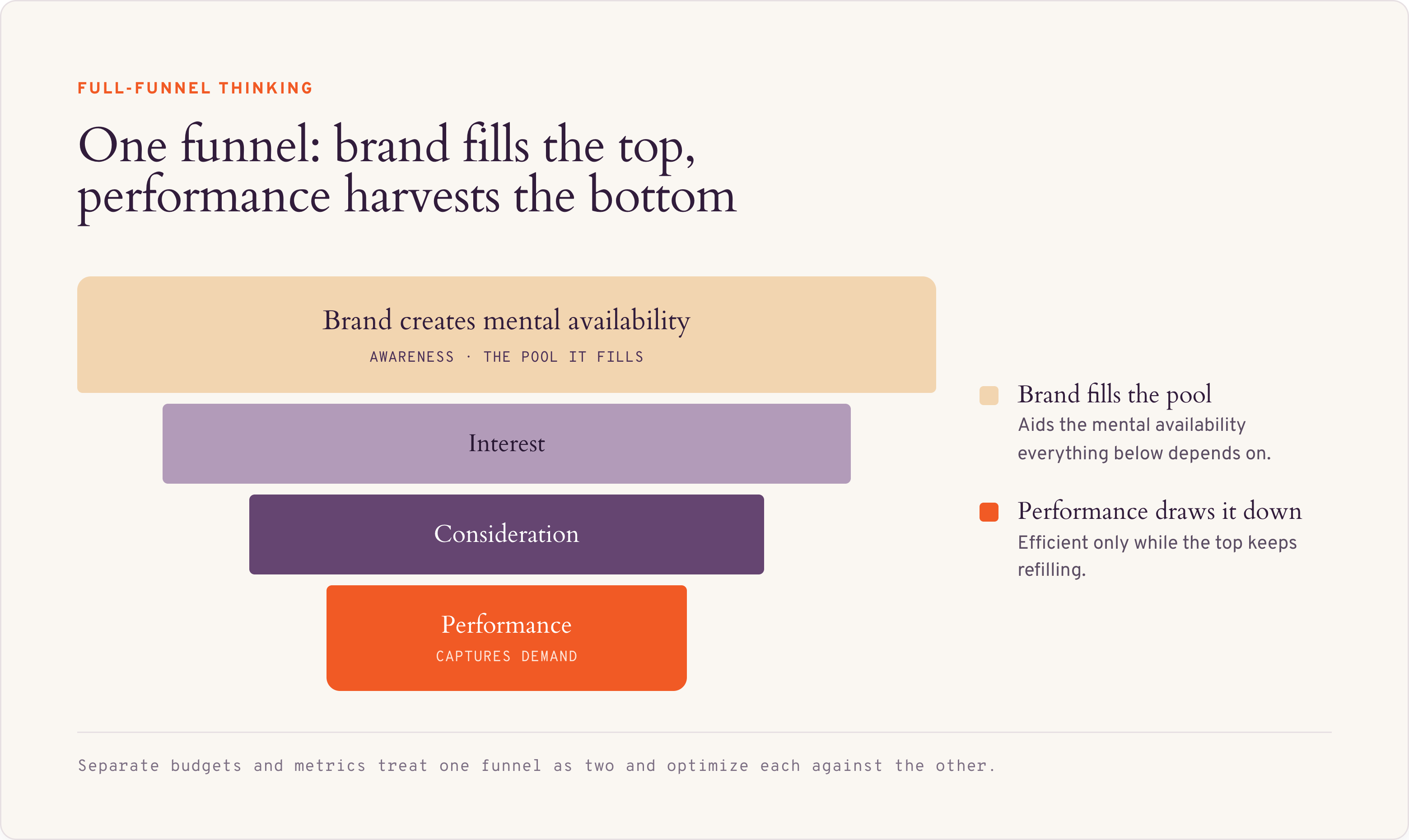
Most organizations split brand and performance marketing entirely. Separate teams, budgets, success metrics, and often a low-grade tension between the two about which one actually drives results.
This misrepresents how marketing actually works. Performance marketing captures already existing demand while brand marketing creates it. When those functions operate in isolation, each one is less effective than it would be with a shared view of what the other is doing.
### What the short-term pressure environment is doing to this
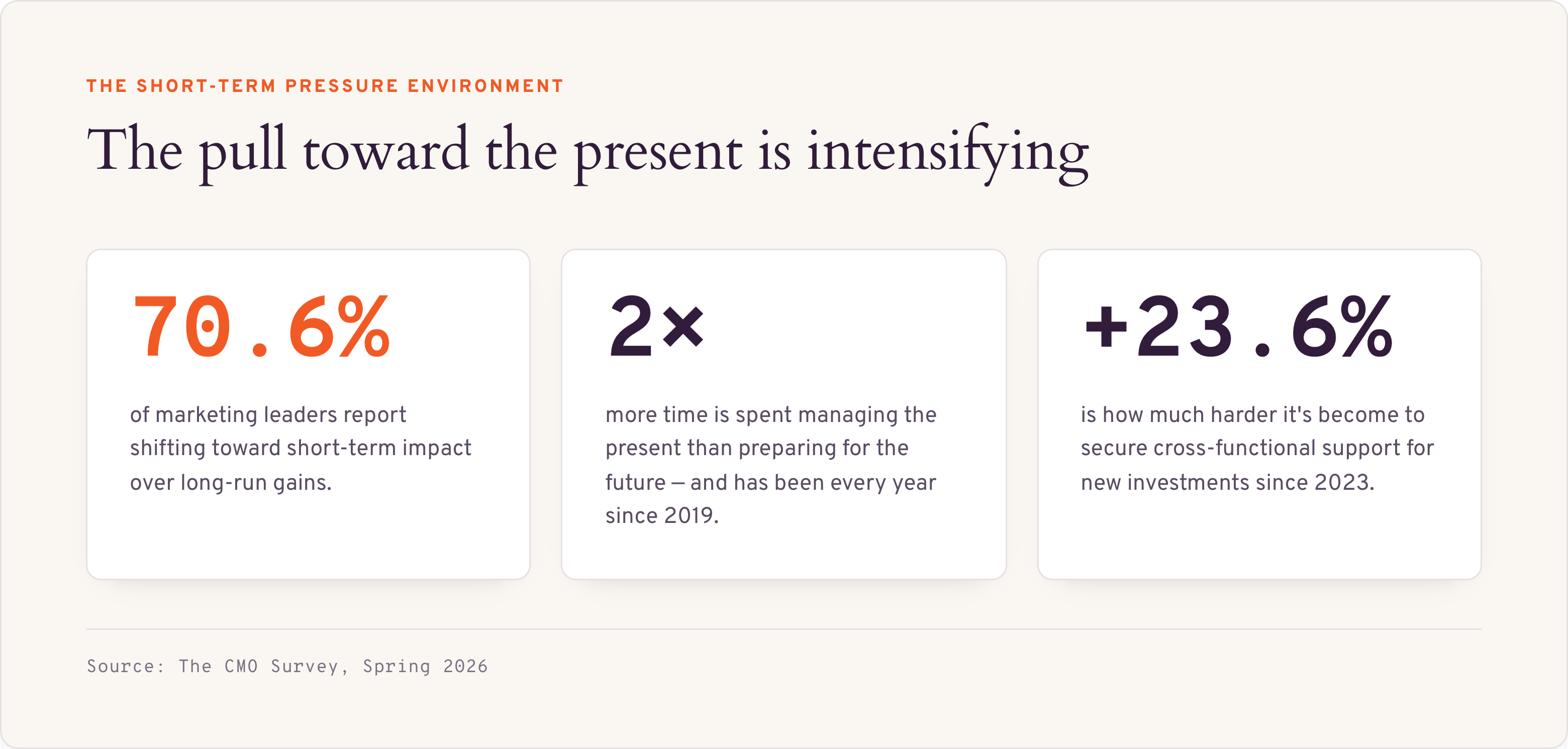
The current pressure environment is making the split worse. When budgets tighten and organizations default to short-term tactics, brand investment is typically the first thing cut. That's understandable in the moment, but it accelerates a longer-term problem: performance marketing becomes increasingly efficient at capturing a demand pool that's slowly shrinking because nothing is replenishing it.
The CMO Survey Spring 2026 data makes this dynamic visible. The predominant response to external pressure from marketing leaders is a shift toward short-term impact over long-run gains, with 70.6% reporting this pattern[(CMO Survey, Spring 2026)](https://cmosurvey.org/results/spring-2026/). Marketers also report spending roughly twice as much time managing the present as preparing for the future, every year since 2019[(CMO Survey, Spring 2026)](https://cmosurvey.org/results/spring-2026/). The short-term orientation isn't new, but the pressure reinforcing it is intensifying.
### How marketing leaders should think about full funnel unification
Full-funnel thinking doesn't require merging teams or restructuring the organization. It requires a marketing leader who understands how brand and performance interact and can make the case for both. In practice, that means:
- Maintaining a shared view of data to inform decisions across the whole portfolio, rather than letting each function optimize independently against its own metrics
- Being able to articulate the relationship between brand investment today and performance efficiency in future quarters
- Resisting the pressure to reallocate brand budgets to performance channels during downturns without understanding the downstream consequences
- Building measurement frameworks that can capture the contribution of both, even imperfectly, rather than defaulting to the metrics that are easiest to track
## Customer intelligence
### Knowing your market better than anyone else in the organization is a foundational leadership responsibility, not a research project
Customer intelligence is slow, qualitative, and hard to tie directly to a campaign metric. In an environment where marketing is under pressure to show short-term financial impact, investing time in understanding customers at a deeper level is easy to defer. There's always a dashboard to build or a report to prepare instead.
But the leaders who skip this work tend to make strategy decisions based on long-standing assumptions. Markets change. Customer behavior shifts. Competitors move. A marketing leader whose understanding of the customer is six months stale is operating on a model of the market that may no longer be accurate.
### How to build better customer intelligence
You don’t need a large research budget. You need a deliberate habit of staying close to customers and using that knowledge for strategy. That looks like:
- Treating customer understanding as an ongoing responsibility instead of something that gets done during onboarding or a brand refresh
- Getting close to qualitative signals (customer conversations, sales call patterns, support themes), not just quantitative performance data
- Knowing which customer segments are most valuable to the business and understanding their behavior, motivations, and decision-making in enough detail to make strategic calls with confidence
- Being the person in the room who can ground strategy conversations in what customers actually do, not just what the organization assumes they do
The first move for any marketing leader shouldn't be diving into ad accounts or demanding new tools. It should be understanding customers at a deeper level than anyone else in the company[(Read: what new marketing leaders should do in their first 90 days)](https://blog.thrivedigital.com/what-e-commerce-marketing-leaders-should-do-in-their-first-90-days). That's true the first year, and it stays true throughout the role.
### What now?
We covered six skills: financial fluency, measurement discipline, AI literacy, cross-functional influence, full-funnel thinking, and customer intelligence. If you're a marketing leader trying to figure out where to start, the honest answer is wherever the gap is biggest in your current role.
That looks different for everyone. A leader who came up through performance marketing probably has strong measurement instincts but may need to invest more in brand thinking and customer intelligence. One who came up through brand may have the opposite problem. Most will find that the financial fluency and cross-functional influence skills are underdeveloped regardless of background, because most marketing career paths simply don't build them.
The harder truth is that organizations aren't going to close these gaps for you. Training budgets have been cut nearly in half from pre-pandemic levels[(CMO Survey, Spring 2026)](https://cmosurvey.org/results/spring-2026/), and that trend isn't reversing. The marketing leaders who keep developing are the ones who take ownership of it themselves: reading widely, staying close to how the industry is changing, seeking out peers and mentors who are strong in the areas they're not, and being honest with themselves about where their thinking has gone stale.
The role will keep changing. The leaders who treat their own development as an ongoing part of the job, rather than something to get to when things slow down, will be the ones best positioned to keep up with it.
## Stay up to Date
Sign up for our mailing list to get our blogs straight to your inbox when we publish them.

## Looking to grow your business in an intelligent way? We can help.
[Work With Us](https://thrivedigital.com/contact)
- [Work](https://thrivedigital.com/work)
- [Process](https://thrivedigital.com/process)
- [About](https://thrivedigital.com/about)
- [Careers](https://thrivedigital.com/careers)
- [Contact](https://thrivedigital.com/contact)
- [Blog](https://blog.thrivedigital.com)
- [Performance Marketing](https://thrivedigital.com/service/performance-marketing)
- [Data & Measurement](https://thrivedigital.com/service/data-measurement)
- [Creative Services](https://thrivedigital.com/service/creative-services)
    
© Copyright 2026 [Terms of Use](https://blog.thrivedigital.com/terms) [Privacy](https://blog.thrivedigital.com/privacy)
[](https://facebook.com/thrivedigital/) [](https://instagram.com/thrive_digital/) [](https://dribbble.com/thrive-digital) [](https://twitter.com/thrive_digital) [](https://linkedin.com/company/thrive-digital/)
```json
{
"@context" : "https://schema.org",
"@type" : "BlogPosting",
"author" : {
"@type" : "Person",
"name" : "Santana Blanchette",
"url" : "https://blog.thrivedigital.com/author/santana-blanchette"
},
"dateModified" : "2026-07-16T18:37:15.444Z",
"datePublished" : "2026-07-16T18:37:15.000Z",
"headline" : "AI, influence, brand, and customers: four skills defining marketing leadership in 2026",
"image" : [ "https://blog.thrivedigital.com/hubfs/2x1_Thrive%20Blog_AI%2c%20influence%2c%20brand%2c%20and%20customers.png" ],
"mainEntityOfPage" : {
"@id" : "https://blog.thrivedigital.com/ai-influence-brand-and-customers-four-skills-defining-marketing-leadership-in-2026",
"@type" : "WebPage"
},
"publisher" : {
"@type" : "Organization",
"logo" : {
"@type" : "ImageObject",
"url" : "https://blog.thrivedigital.com/hubfs/lockup-1.svg"
},
"name" : "Thrive Digital Ltd."
}
}
```