.png) Santana Blanchette
Santana Blanchette

TL;DR
Marketing leaders are under more pressure than ever to justify spend. The ones winning are closing two gaps: the CMO-CFO relationship and measurement discipline. That means learning your CFO's unit economics, building a shared view of marketing's financial contribution, and starting every measurement problem with the business question, not the tool. On attribution, stop chasing the perfect model. Get both teams working from the same imperfect one.
Marketing leaders are doing a lot more than ever before. More responsibility. Less budget. Higher scrutiny.
According to The CMO Survey, even since 2025, marketing's formal responsibilities have grown significantly. Revenue growth, customer insight, and board participation are all up. Meanwhile, budgets have fallen to their lowest share of company revenues in years, headcount growth has stalled, and training investment has been cut nearly in half from pre-pandemic levels.
The pressure to justify every dollar is coming from every direction simultaneously. CEOs, CFOs, and boards have all significantly increased scrutiny on marketing ROI.* And when profits disappoint, marketing gets cut more often than any other expense category.**
The marketing leaders handling these changes well and coming out ahead don't just have more tools or resources. They think strategically about problem-solving and bridging gaps.
So what does strong marketing leadership demand in 2026?
How the role of a marketing leader has evolved
The role of the CMO is drastically different than it used to be. According to Harvard Business Review, CEOs now rank demand generation, customer acquisition, and revenue growth at the top of their priorities for marketing leaders, ahead of customer experience, talent development, and brand building.
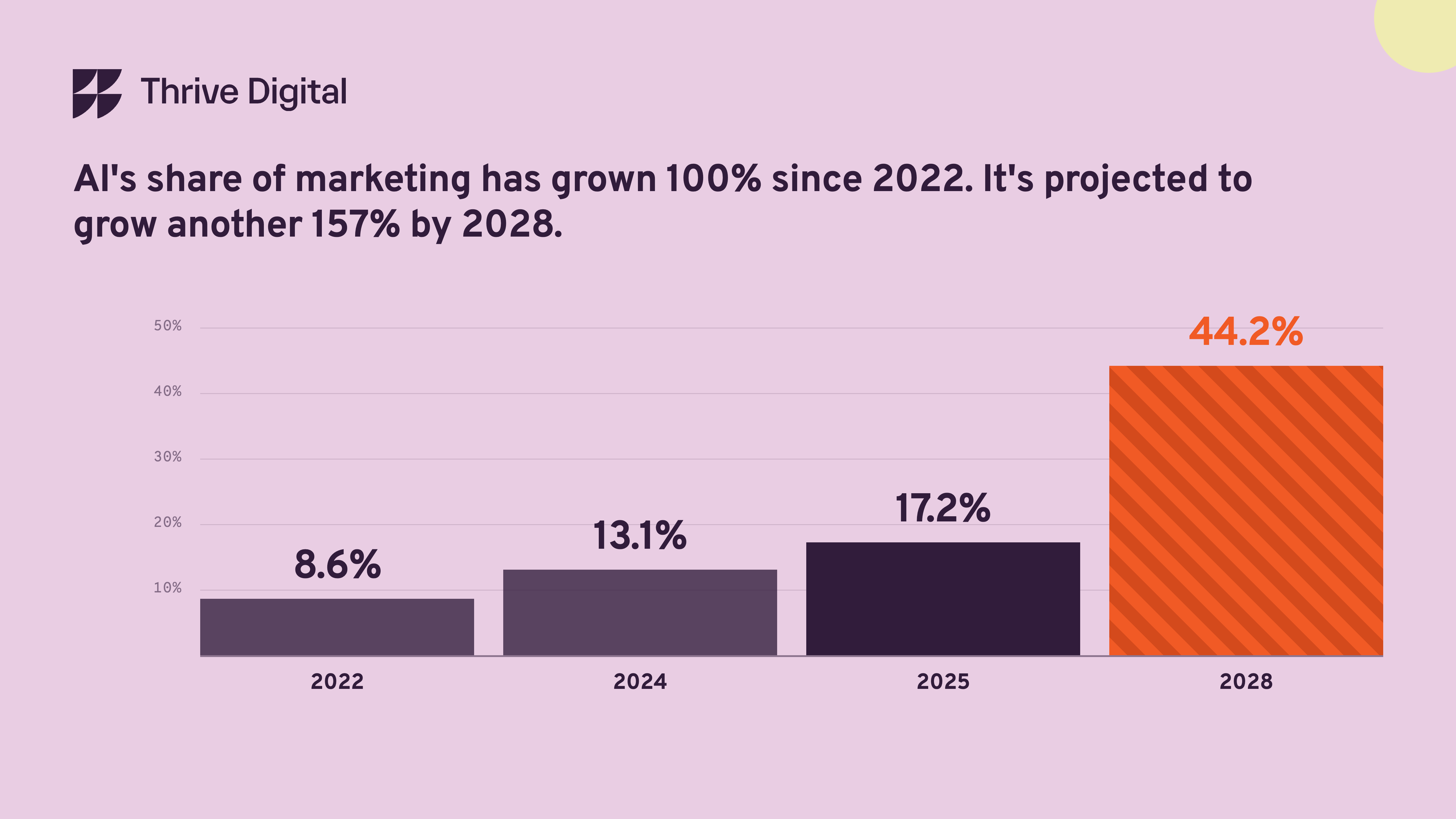
At the same time, AI has doubled as a share of marketing activity since 2022 and is projected to reach 44% within three years. The role now requires genuine fluency across strategy, technology, finance, and analytics. Most marketing career paths weren't built to develop all four.
That gap is where a lot of marketers struggle.
What the current environment is doing to decision-making
Understanding the external pressures shaping marketing decisions right now matters, because many of those pressures are actively working against good long-term strategy.
According to the CMO 2026 Spring Survey, Marketers spend roughly twice as much time managing the present as preparing for the future compared to 2019. When external pressure increases, the predominant response is to double down on short-term tactics and return to established strategies.
That's understandable, but it's also how organizations stop innovating, trying new things, or planning for longer term growth. The CMO Survey points to a few other dynamics worth naming:
- Full-time marketing headcount is declining as organizations shift toward contractors and part-time roles, making it harder to build institutional knowledge over time. If done without solid planning and documentation in place, this can hurt institutional knowledge or create departments where standards are always changing.
- Training budgets have been cut nearly in half from pre-pandemic levels, at exactly the moment skill demands are accelerating. Organizations are asking marketing leaders to develop fluency across strategy, technology, finance, and analytics simultaneously, while cutting the investment that would help them do it. That means the skill-building happening in successful marketing leaders is largely self-directed and intentional, not organizational.
- The CMO-CFO relationship remains structurally weak, with fewer than half of companies reporting that marketing and finance actually work together on growth. This isn't just a personality or communication problem between two individuals. It's a systemic, persistent weakness across the industry, which means the leaders who do close that gap are operating with a genuine competitive advantage over the majority of their peers who haven't.
✓ One topic per month ✓ No spam, ever ✓ Unsubscribe anytime
Skill 1: Financial fluency and business case building
Marketing leaders who speak the CFO's language win more resources and keep them
The top challenge for marketing leaders, consistently, is demonstrating the impact of marketing activity on financial outcomes. This requires strong data and measurement capability, but the CMO-CFO relationship is where that challenge gets resolved or doesn't.
Why the gap exists
The CMO and CFO often operate with fundamentally different definitions of value. Finance is trained to expect precision and short payback windows. Marketing doesn't work that way. Trying to force brand investment through an ROI framework designed for Google Shopping campaigns produces bad decisions on both sides.
The problem compounds over time. When marketing can't speak the financial language of the business, it loses credibility in budget conversations. When it loses credibility, it loses resources. When it loses resources, it gets even harder to demonstrate impact. Many marketing leaders fall into that cycle without even realizing it.
What good looks like
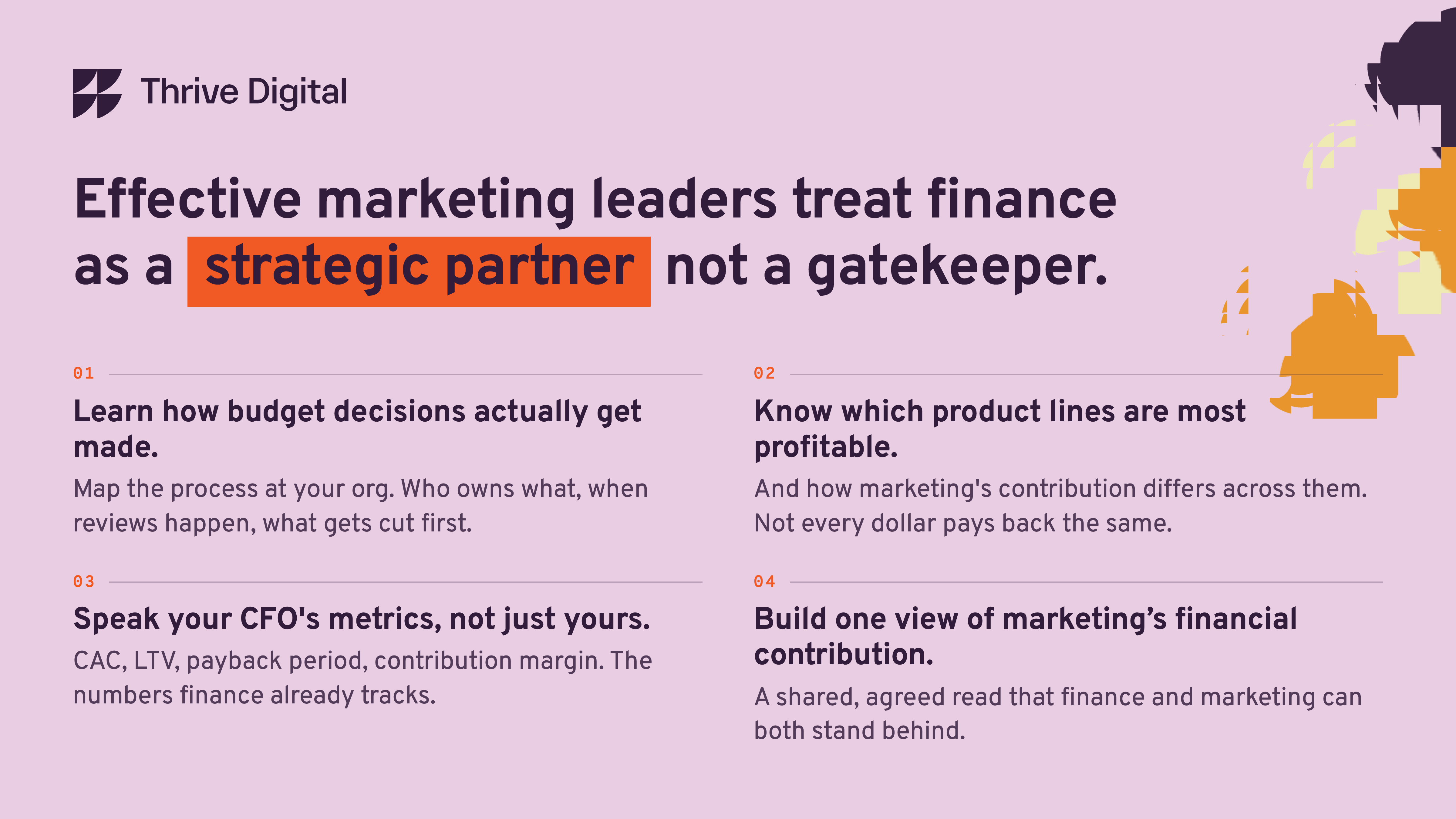
The leaders who close that gap tend to share one habit: they treat finance as a strategic partner rather than a gatekeeper. That means:
- Learning how budget decisions get made at your organization
- Knowing which product categories are most profitable and how marketing contribution differs across them
- Getting familiar with the unit economics your CFO actually tracks, CAC, LTV, payback period, contribution margin, not just marketing metrics
- Building a shared view of marketing's financial contribution that both teams can stand behind
This also means being honest about what marketing can and can't prove. Overclaiming attribution to win a budget argument damages trust. Coming in with solid reporting backed by methodology builds it. The CFOs who become genuine marketing advocates almost always got there through a marketing leader who did the work to earn their respect.
A note on timing: new marketing leaders often make the mistake of diving into strategy before they understand the financial logic of the business. The smarter move is spending the first weeks building that foundation, learning the business economics from finance, before making any strategic changes. The decisions you make afterward will be far more defensible because they're grounded in the financial reality of the organization.
Skill 2: Data, analytics, and measurement strategy
The tools-first approach to measurement is expensive and largely ineffective
Focusing data and analytics on the most important marketing problems has become the fastest-growing challenge for marketing leaders over the past two years*. Most teams aren't short on data. They're short on the discipline to define the question before reaching for a tool.
The tools-first trap
There's a pattern that shows up constantly: a measurement problem appears, someone finds a tool that claims to solve it, the tool gets implemented, and three months later the team has a new dashboard but the same underlying problem. The tool became the solution before anyone properly defined what needed solving.
This isn't a technology problem. It's a thinking problem. And it's expensive. Organizations invest significant budget in analytics infrastructure that produces reports nobody uses to make decisions, because the infrastructure was built around what the tools could measure, not what the business actually needed to know.
What good looks like
The differentiator is building the internal capability to translate between business problems, data, and technology. At Thrive, we've built a dedicated function for strategic analytics and measurement specifically because that translation layer is where most organizations break down. The people who do it well understand business and growth marketing, understand data and technology, and know how to make the output actionable for the teams using it.
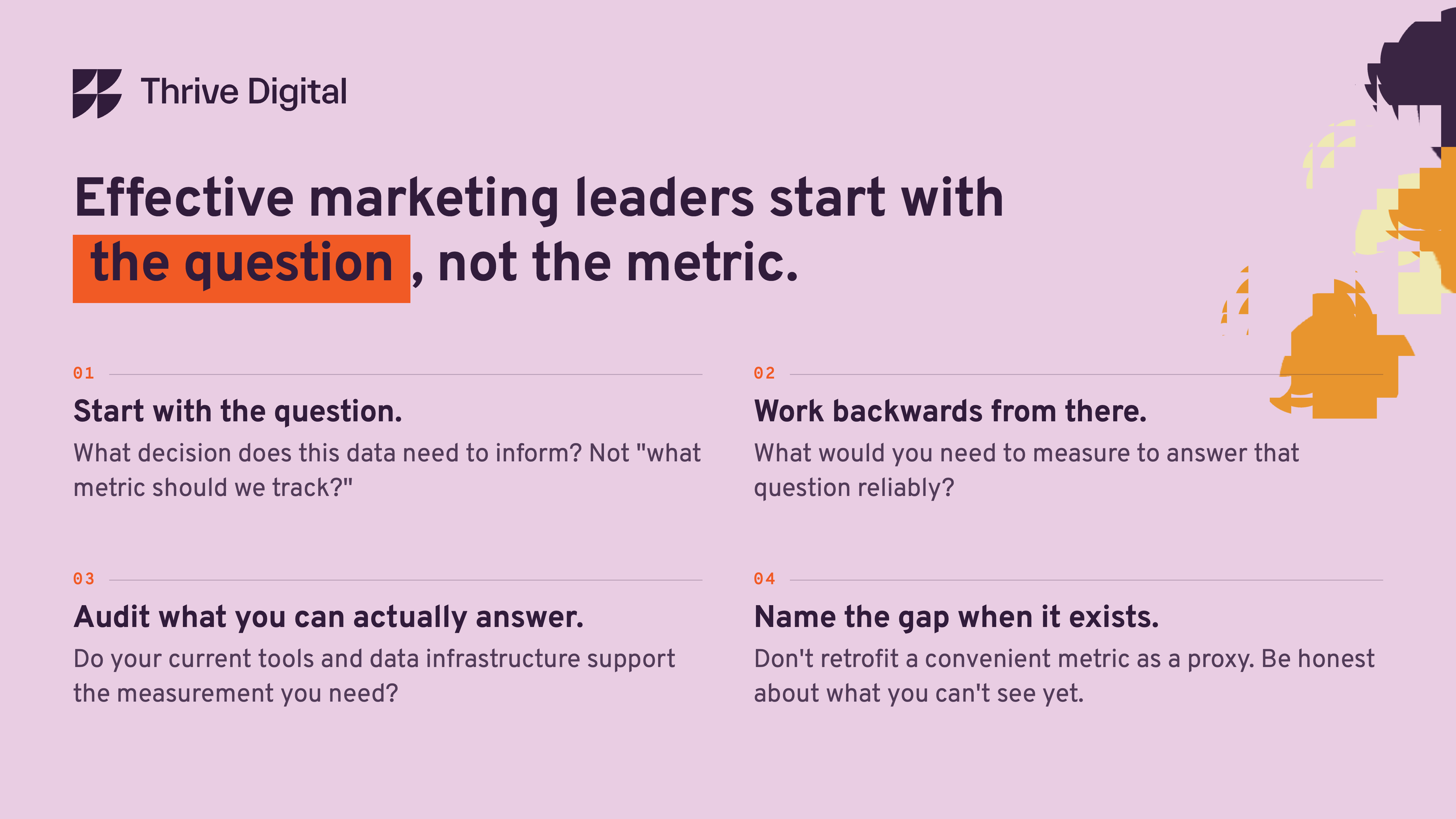
A goals-first measurement approach looks like this:
- Start with the business question, not the metric. What decision does this data need to inform?
- Work backwards to what you'd need to measure to answer that question reliably
- Evaluate whether your current tools and data infrastructure can actually answer it
- If not, be honest about that gap rather than retrofitting an available metric as a proxy
The measurement questions worth investing in are the ones that change how you allocate budget. If the answer to a measurement question wouldn't change anything you do, it's probably not worth the infrastructure to answer it.
You don’t need a perfect attribution model. You need a shared one.
Attribution is one of the most common places this breaks down. Last-click models are still the default in a lot of organizations, even though everyone knows they overvalue bottom-funnel touchpoints and undervalue everything that built the intent in the first place. The problem isn't that people don't know this. It's that fixing it requires organizational alignment that's hard to get when finance and marketing are working from different data.
We don’t need to have the perfect attribution model. We need both teams working from the same shared view of data, even an imperfect one, so that budget decisions are made on a consistent basis rather than each team arguing from their own numbers.
Coming up in this series
In the next newsletter, we'll cover AI literacy (what it actually means to be AI literate as a marketing leader, and what you're handing to your vendors if you're not) and cross-functional influence (why marketing still operates as a silo in most organizations and what it costs).
After that, we'll get into full-funnel thinking and customer intelligence, the two capabilities most at risk of being cut under short-term pressure and the ones that matter most for building something that compounds.